
Trees
Traverse and manipulate hierarchical data structures.
8
Problems
0
Easy
8
Medium
0
Hard
How Trees Works
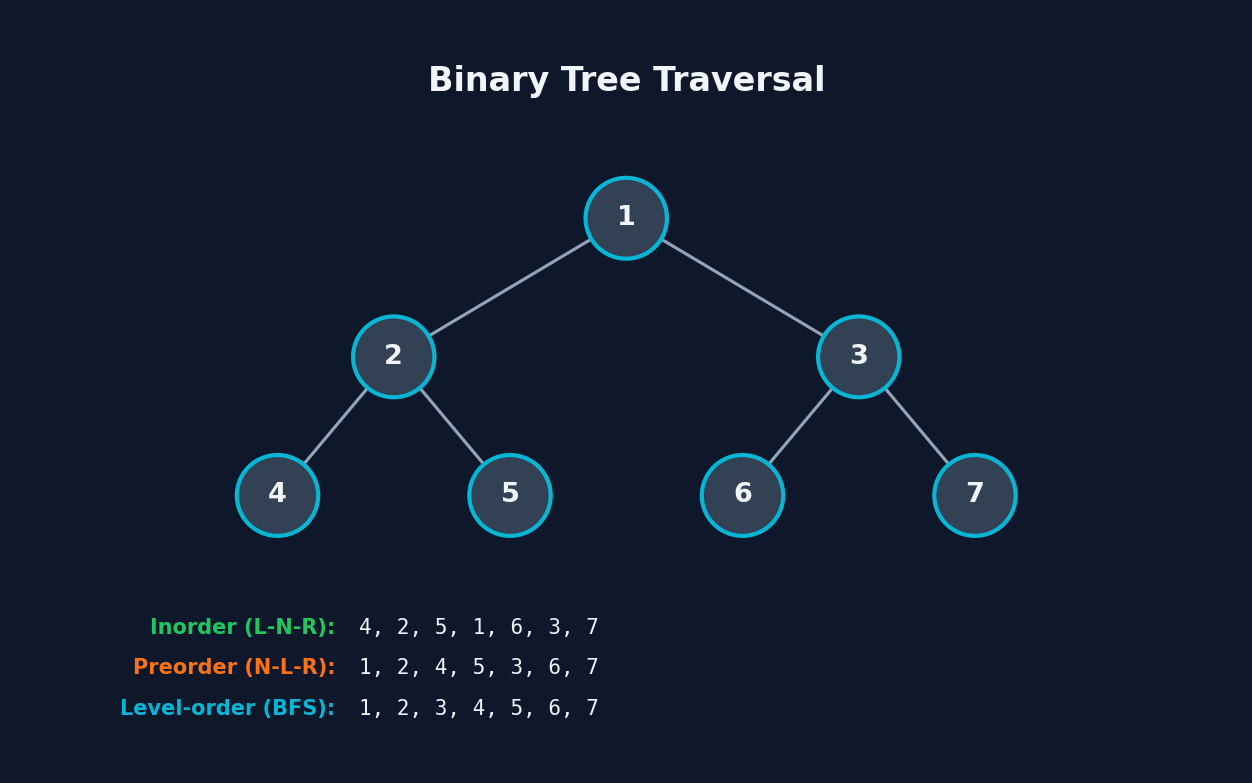
Tree problems are solved recursively by breaking them into subproblems at each node. At every node you have three choices: process the node before its children (preorder), between children (inorder), or after children (postorder). Most tree problems follow a pattern: define what information you need from left and right subtrees, combine it at the current node, and return the result upward. BFS (level-order) uses a queue to process nodes level by level, useful for shortest path or level-specific operations.
When to Use Trees
Pattern Recognition
Look for these trigger words in problem statements:
invert binary tree
trees
maximum depth of binary tree
validate binary search tree
lowest common ancestor of a binary search tree
binary tree level order traversal
binary tree right side view
serialize and deserialize binary tree
binary tree maximum path sum
Common Mistakes
- Not handling the null/None base case (every recursive tree function needs it)
- Confusing when to use DFS vs BFS — use DFS for path problems, BFS for level problems
- Returning values incorrectly in recursive calls (the return value must propagate up)
- Not considering that a tree might be unbalanced, leading to O(n) height instead of O(log n)
When NOT to Use Trees
- When the structure has cycles (it's a graph, not a tree — use graph algorithms)
- When you need to process all pairs of nodes (the recursive approach won't help)
- When the problem is about sequences or arrays with no hierarchical structure
Practice Problems
Invert Binary Tree
medium
Maximum Depth of Binary Tree
medium
Validate Binary Search Tree
medium
Lowest Common Ancestor of a Binary Search Tree
medium
Binary Tree Level Order Traversal
medium
Binary Tree Right Side View
medium
Serialize and Deserialize Binary Tree
medium
Binary Tree Maximum Path Sum
medium
Master Trees
Build pattern recognition with interactive MCQs. Understand why to use Trees, not just how.
Download LeetEye Free