
1-D DP
Solve optimization problems with one-dimensional dynamic programming.
8
Problems
2
Easy
6
Medium
0
Hard
How 1-D DP Works
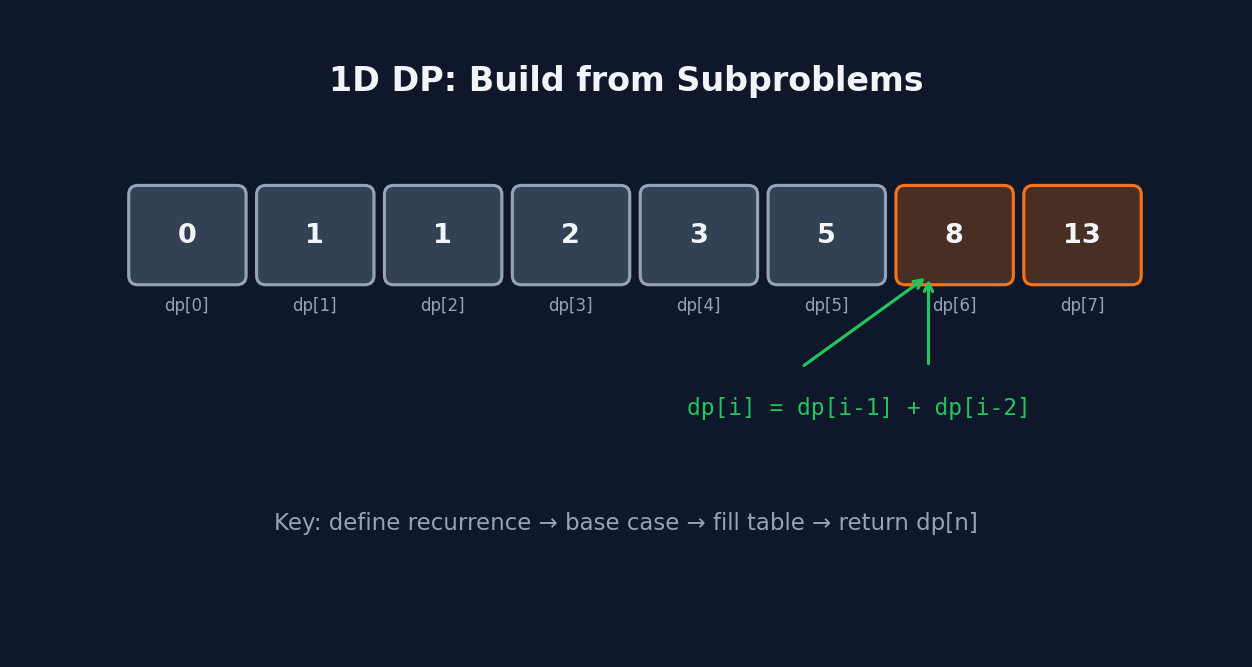
1D Dynamic Programming solves problems by storing solutions to subproblems in an array, where each entry depends only on previous entries. The pattern is: define state (what dp[i] represents), find the recurrence relation (how dp[i] relates to dp[i-1], dp[i-2], etc.), set base cases, and fill the array bottom-up. Classic examples include Fibonacci, climbing stairs, and house robber. Many 1D DP problems can be space-optimized to O(1) by only keeping the last few values.
When to Use 1-D DP
Pattern Recognition
Look for these trigger words in problem statements:
climbing stairs
1d-dp
min cost climbing stairs
house robber
house robber ii
longest palindromic substring
palindromic substrings
decode ways
word break
Common Mistakes
- Wrong state definition — dp[i] must have a clear, consistent meaning
- Missing base cases (dp[0], dp[1] are often special)
- Not considering all transitions — each dp[i] might depend on multiple previous states
- Off-by-one errors in loop bounds when filling the DP table
When NOT to Use 1-D DP
- When a greedy approach provably gives the optimal answer
- When the problem doesn't have overlapping subproblems (use divide and conquer)
- When the state space is too large to fit in memory
Practice Problems
Master 1-D DP
Build pattern recognition with interactive MCQs. Understand why to use 1-D DP, not just how.
Download LeetEye Free